Tokenomics
$BLEP UTILITY
Agent Work Credits, Agent Strategy Marketplace, Bleeep Prop are not yet active or incorporated into the current litepaper. Pricing, eligible uses, limits, expiry, remedies, supported services, and activation sequence will be finalized before release.
Product-linked Agent utility
BLEEEP Agent connects $BLEP utility to defined, measurable services rather than passive token ownership. Agent research, private exploratory testing, premium data, and storage place different demands on models and infrastructure. Eligible services are therefore priced in a stable reference unit and settled in the exact $BLEP amount shown in a time-limited quote.
The governing principle is simple: $BLEP pays for identifiable Agent work; it does not purchase truth, performance, or trading authority. A token payment or Work Credit balance cannot buy a strategy GO, alter a Validation Record, improve an evidence label, buy priority in a neutral verification process, expand an execution mandate, or guarantee a trading result. Public proof inspection and access to published verification records remain available without purchasing Work Credits.
Non-transferable Agent Work Credits
A confirmed $BLEP payment can create a prepaid BLEEEP Agent service balance represented internally as Agent Work Credits. Work Credits allow variable-cost Agent activity to be measured without requiring a separate onchain transaction for every request.
Agent Work Credits are non-transferable, offchain service-account units. They are not $BLEP, a second crypto token, a stablecoin, or a tokenized claim on assets. They cannot be withdrawn to a wallet, transferred between users, traded, staked, pledged as collateral, or used for governance. They provide no yield, profit-sharing right, or on-demand redemption right.
Eligible Work Credit uses may include:
- premium model access;
- extended private exploratory backtests;
- parameter sweeps and stress tests;
- premium datasets;
- scheduled private Agent work and long-running private monitoring;
- extended private-workspace or raw-data retention beyond any required public record; and
- private-workspace bulk exports.
Paid exploratory work does not become canonical validation merely because BLEEEP Agent performed it. Work Credits cannot create or improve a Strategy Validation Record, accelerate or replace required proof generation or evidence-status processing, or purchase priority in a correction, appeal, or other neutral verification function. If a privately generated artifact is later submitted for formal validation, it enters the ordinary methodology, evidence, and review process without purchased priority.
Before billable work begins, BLEEEP shows the estimated charge or applicable usage basis and the maximum amount that may be consumed without further authorization. The required Work Credits are reserved when the job is accepted and consumed only under the disclosed completion rules. Unused reservations are released. A covered platform failure results in the published recredit or other service remedy, while any monetary remedy follows the separately disclosed $BLEP refund terms.
Purchased, promotional, reserved, consumed, recredited, and expired balances are recorded separately. Promotional Work Credits do not represent a user token payment. Expiry, rollover, cancellation, and recredit terms are disclosed before a user purchases the corresponding service entitlement.
Settlement and token flow
An eligible Agent service is displayed in a stable reference unit and converted into an exact, time-limited $BLEP quote. The quote identifies the underlying Agent service amount, any separately applicable Ecosystem Reserve Fee, the combined transfer amount, and its expiry. Stable-reference pricing makes the service value understandable during checkout; it does not stabilize the market value of $BLEP or guarantee token liquidity.
The economic flow is:
$BLEP product payment
-> Agent service settlement
-> Work Credits recorded
-> Work Credits reserved and consumed as eligible Agent work is delivered
-> earned BLEEEP-owned $BLEP enters the Utility Vault

Any separately identified Ecosystem Reserve Fee
-> separate settlement
-> Treasury Reserve after the related obligations are resolved
Recording paid Work Credits creates a service obligation. The corresponding product payment is not treated as fully earned merely because checkout succeeded. Amounts associated with unconsumed Work Credits remain service obligations. Amounts associated with reserved work or unresolved remedies remain restricted under the disclosed settlement terms. The corresponding BLEEEP-owned amount becomes earned only as the service is delivered and the applicable remedy obligations expire or are resolved, or another disclosed terminal condition applies.
Work Credits themselves never enter the Utility Vault or Treasury. They are internal accounting units. Only BLEEEP-owned $BLEP earned under these settlement and remedy terms enters the Utility Vault. A recredit restores the internal Work Credit balance and is not a token transfer. Any approved monetary refund returns $BLEP under the applicable settlement and remedy terms.
No Agent payment automatically triggers a burn, retirement, liquidity deployment, market purchase, holder reward, revenue distribution, or redemption right. Later Utility Vault or Treasury treatment follows the separately disclosed allocation framework.
Product and ecosystem boundaries
Agent Work Credits cannot be used as a substitute for $BLEP in the Agent Strategy Marketplace, a Prop Challenge, a refundable Creator Integrity Stake, another role-specific token commitment, or provider or participant capital. They do not create access to Marketplace content or pay creator compensation. Marketplace subscriptions and creator compensation retain their separate $BLEP settlement flow and underlying entitlement rules.
Agent Work Credits are service-account units. They are not transferable assets, investment products, trading capital, proof of skill, or guarantees of profit, uptime, execution, or validation. They connect $BLEP to identifiable Agent work without affecting the integrity of validation or public proof.
BLEEEP Prop Challenge fees
A participant pays a per-attempt $BLEP fee, priced in a stable reference unit, for one registered paper Challenge attempt. Any applicable Ecosystem Reserve Fee is identified separately at checkout. Neither amount is trading capital, a deposit, part of the virtual reference balance, a Qualification Stake, or an operator bond, and neither guarantees PASS, profit, Network eligibility, provider selection, funding, or favorable treatment.
Challenge payments enter designated settlement custody. Any underlying payment or Reserve Fee component required for an approved monetary remedy remains restricted until the obligation is resolved. A monetary refund is returned in $BLEP; the purchase terms identify the refundable token quantity and treatment of the associated Reserve Fee.
After the evaluation service is delivered and all applicable remedy obligations expire or are resolved, the non-refundable underlying Challenge fee becomes earned BLEEEP revenue and enters the Utility Vault. An earned Ecosystem Reserve Fee follows the separate Treasury Reserve path. Payment does not itself trigger a lock, token retirement, community allocation, liquidity deployment, market purchase, holder yield, redemption right, or revenue-sharing claim.
Agent Strategy Marketplace token flow
The Agent Strategy Marketplace uses $BLEP to settle time-bounded access to eligible signal streams. A creator selects a price in a stable reference unit, and checkout converts it into an exact $BLEP quote that separately identifies any applicable Ecosystem Reserve Fee. The subscriber remains responsible for whether and how signals may be acted on, including any per-signal approval or advance execution mandate.
The underlying Marketplace payment is divided into a creator share and a Marketplace Service Fee. The creator share compensates the creator for the access right sold. The service fee compensates BLEEEP for discovery, access administration, delivery, version tracking, eligibility monitoring, evidence presentation, proof support, and settlement. Any applicable Ecosystem Reserve Fee is shown separately and is not included in either share.
At settlement, the underlying Marketplace payment is provisionally allocated between the creator share and Marketplace Service Fee. Either provisional amount may remain restricted while delivery, cancellation, correction, refund, credit, or remedy obligations remain open. Once those obligations are resolved, the creator payable is quantified and segregated for release, while the Marketplace Service Fee becomes earned BLEEEP revenue and enters the Utility Vault. An earned Ecosystem Reserve Fee follows the separate Treasury Reserve path.
When an approved remedy is monetary, it is returned in $BLEP under the disclosed quantity and Reserve Fee treatment. A service extension or credit is an access right rather than a token transfer.
Creator Integrity Stake
After creator and listing approval, an approved, accountable creator offering paid subscriptions maintains one standardized, refundable Creator Integrity Stake at the creator level, subject to the published limit on active paid listings, while any relevant listing, subscriber right, delivery duty, remedy period, or integrity review remains open. The token commitment supports creator identity, authority, rights, disclosure, version, and delivery integrity.
It does not validate the strategy, guarantee profit, insure subscriber losses, replace restricted settlement balances, or buy Marketplace approval or ranking. Ordinary underperformance is not forfeitable. A creator that initiates exit stops accepting new paid subscriptions before release of the token commitment can begin.
Qualified Capital Network utilities
Historical qualification remains visible without a token stake. The Network separates operator eligibility, provider offers, service fees, and any funded-mandate integrity bond. Each token commitment applies only to its stated role after the relevant non-token eligibility requirements are satisfied.
Qualification Stake
After obtaining the required scoped Prop qualification and completing the separate current-eligibility assessment, an operator seeking active, selectable Network status maintains the standardized refundable Qualification Stake. It activates duties concerning identity and credential continuity, accurate disclosure, profile maintenance, and availability of the records required for ongoing eligibility. It does not alter the historical Prop result, improve ranking or selection priority, prove current capacity, or create an entitlement to an offer or funded mandate; each provider retains its separate selection and mandate decision.
Withdrawing the stake removes the operator from new selection but does not erase the historical qualification record or convert the stake into a payment. The same token quantity normally returns after offers and mandates linked to the operator are resolved and the published release and review conditions are met.
Provider Offer Commitment Lock
A verified capital provider posting an active offer maintains a refundable token commitment linked to that offer. Its purpose is to deter materially false offers, false proof of authority or funds, impersonation, and unjustified failure to honor an accepted offer.
The lock does not itself prove identity, authority, solvency, or control of funds; those require separate verification. The same token quantity normally returns when the offer expires, is validly withdrawn before acceptance, or is funded as agreed.
Network Service Fees
A capital provider may pay $BLEP for identifiable activation or administration services. Any applicable Ecosystem Reserve Fee is identified separately from the underlying Network Service Fee. Public qualification records and neutral discovery remain free. A Network Service Fee becomes earned only as BLEEEP provides the disclosed activation, monitoring, proof, reporting, reconciliation, settlement, or mandate support; once earned, it enters the Utility Vault. An earned Ecosystem Reserve Fee follows the separate Treasury Reserve path. Provider capital remains separate from these fees.
Funded Operator Bond
A commercial funded mandate may require its operator to maintain a separate refundable integrity bond before the provider issues an execution mandate. The bond supports narrowly defined operator-integrity duties during the funded relationship. It is not a performance stake, market-loss insurance, source of order-routing authority, or guarantee that provider capital will be made whole.
The bond may permit a verified, capped direct-harm remedy after an integrity breach. Any remainder stays segregated and is not automatically recognized as revenue, allocated to rewards or liquidity, redistributed, or retired.
Community-Formed Mandate Pool
A Community-Formed Mandate Pool allows an eligible initiator to publish a fixed pool mandate and invite eligible participants to subscribe capital voluntarily. The working principle is initiator-defined, community-funded, and non-voting: participants choose whether to join the published pool mandate rather than repeatedly voting on its operating rules.
The initiator maintains a refundable $BLEP token commitment supporting accurate disclosure and identity continuity. That token commitment is not pool capital, does not grant voting power, does not insure market loss, and does not select the operator. Subscription capital is a separate asset and need not be $BLEP.
The pool activates only if its funding and participation conditions are met. A separately qualified trader or accountable AI operator completes a pool-specific selection process and may receive staged, capped, trade-only authority through a separate execution mandate issued by the pool’s authorized account or custody controller under the disclosed pool controls, without a general ability to withdraw participant assets. Pool accounting distinguishes participant units, net asset value, profit, loss, fees, and withdrawal claims.
Before subscriptions open, the pool mandate defines its activation threshold, operator-selection process, authority stages and caps, fee basis, profit-and-loss allocation, withdrawal treatment, operator replacement, termination, and closeout. It defines the commercial and operating terms but does not itself authorize order routing. Activation depends on released custody, valuation, liquidity, and participant-protection rules covering that lifecycle.
Provider capital remains separate
Capital associated with a Qualified Capital Network funded mandate remains in a provider-controlled account, subaccount, or delegation arrangement. It is not paid to BLEEEP as a token fee, posted as a Qualification Stake, included in an operator bond, or counted as a Utility Vault or Treasury asset.
$BLEP pays for defined services or supports defined token commitments around qualification and funded mandates. It does not replace allocated capital, give token holders a claim over provider assets, or turn provider capital into a protocol-owned pool.
If a Community-Formed Mandate Pool is later approved, it uses its own segregated custody and accounting architecture and does not change the provider-capital separation rule.
Custody, circulation, and accounting
A settled, earned payment transfers token ownership in exchange for a service or access right. Before earning, an amount subject to a customer, creator, refund, or remedy obligation remains a restricted settlement balance. A refundable token commitment instead restricts liquidity temporarily and normally results in the same token quantity being returned.
Challenge and Marketplace settlement balances, creator payables, earned Utility Vault receipts, Ecosystem Reserve Fees, refundable token commitments, separately held forfeiture balances, provider and pool capital, and launch-allocation balances are accounted for separately by source, asset, ownership, and purpose. Customer, creator, provider, and pool-participant claims are not BLEEEP-owned Utility Vault or Treasury assets.
Custody, token locks, buybacks, and returns of committed tokens do not mint new $BLEP or necessarily change total supply. Any supply or market-availability effect follows the actual transfer, lock, burn, or retirement mechanism and is reported accordingly.
Initial settlement destinations follow the disclosed accounting policy. No later Utility Vault or Treasury use is automatic: a product payment does not by itself determine a lock, retirement, program allocation, liquidity deployment, market purchase, or conversion, and participants acquire no right to demand any such action.
Treasury and Utility Vault
BLEEEP uses one settlement layer followed by two BLEEEP-owned allocation destinations. The Utility Vault receives earned $BLEP from direct product use. The Treasury receives Reserve Fees, external revenue, and net realized income from Treasury-managed liquidity. This is an accounting and allocation boundary; it does not require two specific smart contracts or custody arrangements.
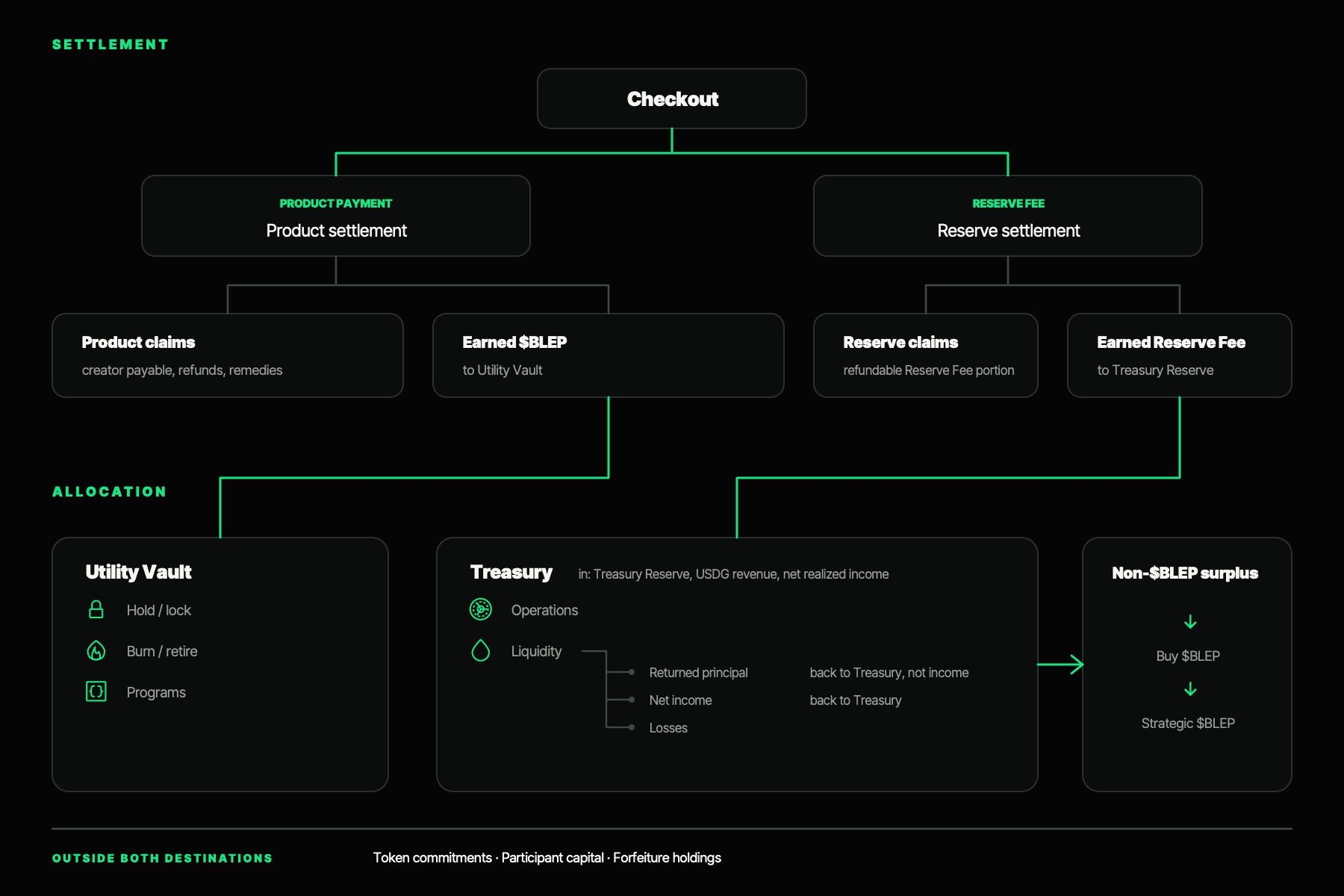
In this flow, product claims include creator payables, approved refunds, and monetary remedies. Reserve Fee claims include the refundable Reserve Fee portion of an approved refund or remedy. Both remain outside BLEEEP-owned allocation destinations. Credits and unearned amounts remain separate settlement obligations. Launch-allocation balances are omitted from this operating flow.
Utility Vault
The Utility Vault receives only the earned BLEEEP-owned $BLEP portion of direct product payments after customer obligations are resolved and any creator payable is quantified and segregated. Its sources include earned BLEEEP Prop Challenge fees, Marketplace Service Fees, and Network Service Fees. Gross Marketplace payments, creator shares, refundable amounts, token commitments, participant capital, and forfeiture holdings do not enter the Utility Vault.
Utility Vault assets may be retained, placed under a disclosed time lock, retired through a disclosed mechanism, or allocated to disclosed community and ecosystem programs. BLEEEP reports the actual mechanism and its effect: a contract-level burn may reduce onchain total supply, while another retirement or lock may affect only accessible or market-available supply.
The Utility Vault is a BLEEEP-controlled allocation destination. It is not participant custody, a depositor account, passive-yield product, the execution Safety Vault, or a separately accounted forfeiture holding.
Treasury
The Treasury receives earned Ecosystem Reserve Fees, volume-based USDG revenue received through Virtuals, and net realized income from Treasury-managed liquidity after associated costs. Each inflow is accounted for separately by asset type, origin, and purpose.
The Reserve Fee is calculated from the underlying product amount and shown separately in the same checkout quote. For a Marketplace transaction, the underlying product amount, not the combined checkout total, is divided into the creator share and Marketplace Service Fee. Once settlement and remedy obligations are resolved, the earned Reserve Fee enters the Treasury Reserve. It does not apply to refundable token commitments or provider or participant capital.
The Treasury Reserve supports operating continuity, security, development, and other disclosed ecosystem needs. Only a bounded portion of eligible Treasury assets may be deployed to provide liquidity. Returned liquidity principal is not income. Principal, associated costs, net realized income, and losses are accounted for separately, and net income may replenish the Treasury Reserve.
After operating and reserve needs are met, eligible surplus non-$BLEP Treasury assets may fund periodic market purchases of $BLEP. Purchased tokens remain separately labeled as Treasury-owned strategic assets. They are not automatically retired or relabeled as direct-product Utility Vault receipts, and any later use preserves their Treasury-acquisition provenance.
Rights and accounting boundary
Creator and customer claims, unearned amounts, refundable token commitments, provider and community-pool capital, and separately held forfeiture balances remain outside the Utility Vault and Treasury until the applicable obligations or disposition processes are resolved. Accounting for a transaction does not make every amount in that transaction a BLEEEP-owned asset.
Neither system gives $BLEP holders a claim over BLEEEP assets or allocation decisions. The framework creates no dividend, revenue share, guaranteed retirement, guaranteed buyback, redemption right, passive return, or commitment to support the market price of $BLEP.
Neutrality and participant rights
Access to an evidence-based correction, incident response, or review available under the published rules may not require a new fee, appeal bond, additional stake, or unrelated token balance. An already-posted role-specific token commitment may remain restricted through its disclosed review and appeal period. $BLEP ownership creates no claim over Utility Vault or Treasury assets, provider capital, Community-Formed Mandate Pool assets, BLEEEP revenue, fee custody, creator earnings, or restricted balances. It does not guarantee returns, funding, liquidity, or token value.
Token risk and legal boundary
$BLEP carries smart-contract, custody, liquidity, market, and price risk and may lose all value. The token itself does not grant equity, ownership, dividends, revenue distribution, profit sharing, redemption, or guaranteed return rights. Any separate economic right in another product arises only from explicit participation in that product, not from ordinary $BLEP ownership or a refundable token commitment.
Nothing in these docs is investment advice or an offer or solicitation to invest or enter a funded mandate. Product and token availability may be restricted by the conditions applicable at release. See the full disclaimer.
Next: Roadmap and vision covers release sequencing.