The validation engine (L0)
L0 accepts a frozen strategy specification, the registered market-data input, and the controlling Validation Standard. It returns GO, NO_GO, or INSUFFICIENT with the metrics and proof references supporting that result. BLEEEP does not claim ownership of a submitted strategy; the user remains responsible for securing all required ownership, licensing, and use rights. BLEEEP supplies and versions the evaluation standard.
Control and disclosure boundary
The user controls the strategy’s logic, parameters, markets, sizing, and risk limits. BLEEEP controls the prospectively published Validation Standard, including strategy-family classification, applicable tests, ordering, and passing thresholds. Equivalent submissions under the same standard version face the same criteria, and a completed result cannot be recalculated under a more permissive rule selected afterward.
The public disclosure may include the strategy-version identifier, standard, disclosed inputs, metrics, verdict, rejection reason, and proof status without publishing the underlying strategy logic. Cryptographic commitments establish the provenance of the disclosed artifact; independent reproduction still requires the necessary logic, data, and computation.
Capture-first evaluation
Capture-first separates attempt admission, data registration, strategy freezing, scoring, and forward observation:
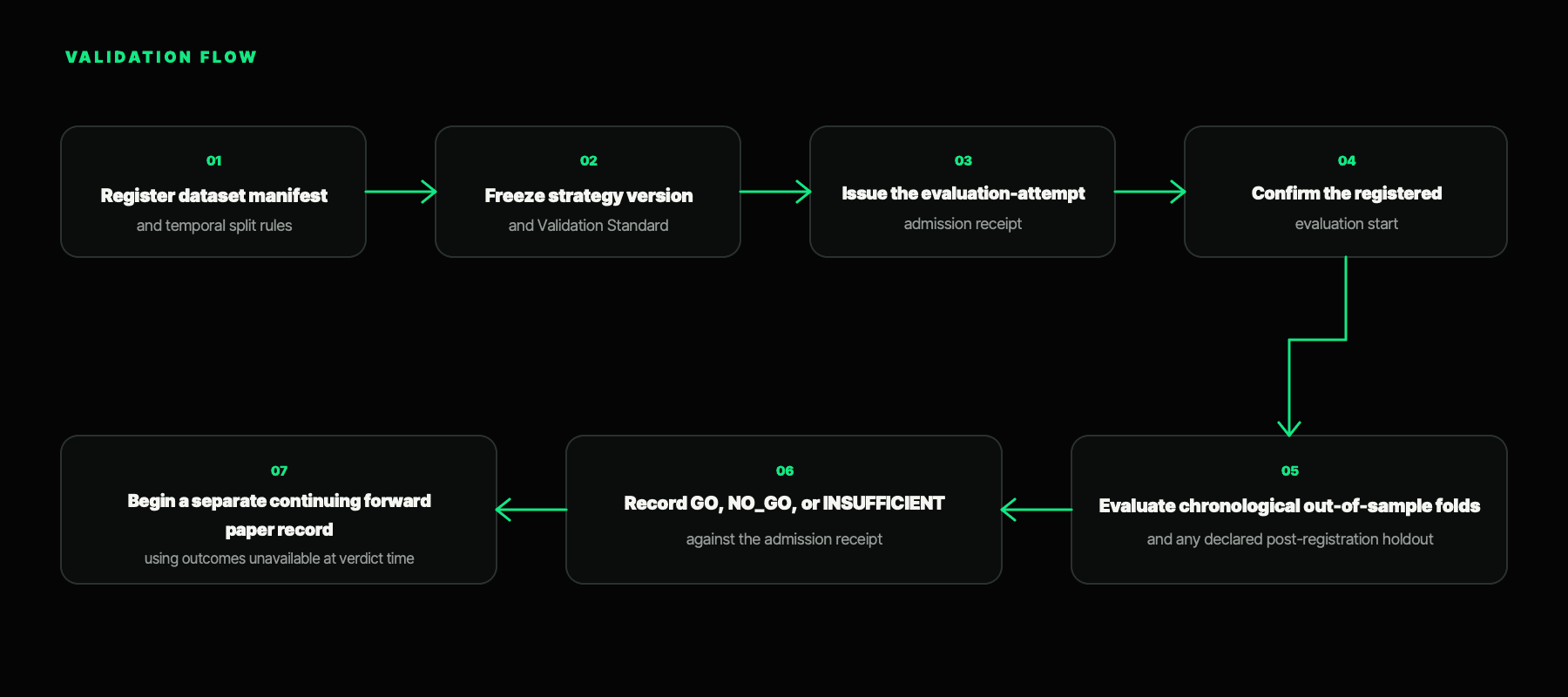
Before scoring begins, the admission receipt confirms that the attempt has entered the registered evaluation with its frozen strategy version, dataset manifest, temporal split rules, and Validation Standard. A late, invalid, withdrawn, interrupted, unresolved, or unrevealed attempt retains its applicable Index status rather than disappearing from the admitted denominator.
Historical validation may use chronological walk-forward folds whose observations already exist, provided that the fitting and out-of-sample boundaries are frozen before scoring. A declared post-registration holdout uses outcomes that arrive only after the strategy and standard are frozen. This limits look-ahead and post-registration tuning inside the registered run; it does not prove that unregistered variants, earlier research overfitting, leakage, or bad data never existed.
Next: Validation methodology lists the gates a candidate must pass.